

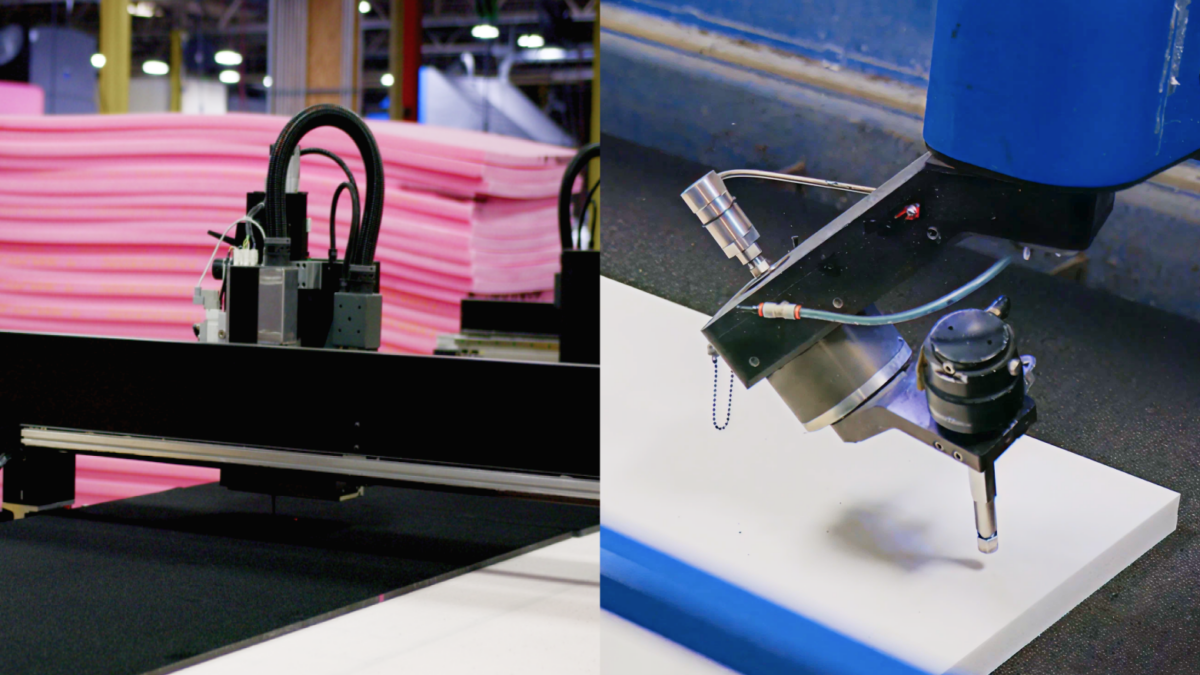
Die cutting, waterjet cutting, and CNC routing are the workhorses of precision foam fabrication. They cover the widest range of foam geometries and production volumes. Understanding what each method does best means every part you produce is built on the right process from day one.
Die Cutting is Scalable, Repeatable, and Precise
Foam die cutting is a manufacturing process that uses a custom-shaped steel rule die to cut foam materials into consistent shapes and sizes quickly, cleanly, and at scale. Precision die cutting produces high volumes of foam parts with consistent dimensions, tight tolerances, and high repeatability. From industrial gaskets and seals to custom packaging inserts and cushioning components, die cutting is a cost-efficient, high-throughput solution.
How it works:
Die cutting begins with creating a custom steel rule die. A thin, sharp blade is shaped to match a part’s profile and then mounted into a die board. Foam sheets or rolls are then placed into a hydraulic or rotary press, which uses high pressure to stamp out the shapes. Once the die is created, the manufacturing process is fast and simple. Depending on part geometry, production volume, and material, Amcon offers flatbed die cutting (for thicker materials and complex shapes) and rotary die cutting (for thin foams and high-speed production).
Best for:
- Protective packaging inserts for tools, electronics, and medical equipment
- Custom gaskets and seals for HVAC, industrial, and automotive systems
- Foam pads and spacers for vibration isolation and cushioning
- Medical and orthopedic foam components
- Sound-dampening materials for electronics and enclosures
- Retail foam packaging with clean, branded presentation
- Laminated multi-layer assemblies in manufacturing and OEM products
Die cutting is the preferred method for producing large quantities of uniform foam parts. Once the die is created, foam parts can be cut rapidly and in bulk, making it ideal for production lines, kitting operations, contract packaging, and OEM component sourcing. Per-part cost drops significantly as volume increases, making die cutting one of the most economical options for repetitive designs.
Amcon offers in-house die design, fabrication, and cutting capabilities, with several types of die cutting machines at its converting facilities, allowing for scaling to full production or creating short-run kits for testing or specialty packaging.
Compatible materials:
- Polyethylene (PE)
- Cross-Linked Polyethylene (XLPE)
- Polyurethane (PU)
- Expanded Polyethylene (EPE)
- Expanded Polypropylene (EPP)
Waterjet Cutting Provides Precision and Flexibility for Clean Foam Fabrication
Waterjet cutting is a high-precision, cold-cutting foam fabrication method that uses a high-pressure stream of water to slice through foam materials cleanly and accurately. There is no heat, no mechanical stress, and no material distortion.
How it works:
Waterjet cutting systems work by forcing ultra-high-pressure water streams (up to 60,000 psi) through a narrow, computer-controlled nozzle to make precise cuts through nearly any type of foam. The process is non-abrasive and clean, avoiding overcutting, material degradation, and jagged edges. Using CAD-based designs, foam sheets or blocks can be cut into custom shapes, contours, cavities, and inserts with exceptional accuracy and clean edges. There is minimal material waste and no tooling required. Unlike laser or die cutting, waterjet cutting is a cold-cutting process. There is no melting or warping, no hard edges or heat-affected zones, and no chemical degradation of foam structure. It can be used on thermally sensitive foams.
Best for:
- Low-to-mid volume production, product launches, and custom foam solutions with frequent design updates
- Protective packaging inserts for electronics, medical devices, and more
- Custom case interiors for tools, military gear, and more
- OEM foam components for appliances, industrial machinery, and automotive
- Medical-grade cushioning and supports
- High-performance gaskets, seals, and spacers
Compatible materials:
- Polyethylene (PE)
- Cross-Linked Polyethylene (XLPE)
- Polyurethane (PU)
- Expanded Polyethylene (EPE)
- Expanded Polypropylene (EPP)
Amcon’s waterjet capability:
- 5 waterjet machines (5 times more than local competitors)
- A 5-axis waterjet cutting machine (the only one of its kind in the area)
- 20+ cutting heads
CNC Routing & Pattern Cutting: Precision-Machined Foam for Complex Shapes and Custom Inserts
CNC (Computer Numerical Control) foam cutting is a computer-guided foam converting method that uses precision cutting tools to create highly detailed, intricate shapes. It is ideal for custom foam parts that require tight tolerances, multi-depth cavities, and complex geometries, including applications like custom foam inserts for high-end packaging, product presentation, and engineered components.
How it works:
CNC routing uses a programmed toolpath to move a cutting head along multiple axes, carving shapes, pockets, and contours into foam sheets or blocks. The process is fully digital, driven by CAD files that define the part geometry.
- Engineers create or import CAD models that define each cut, cavity, and profile. Software generates toolpaths that follow these designs precisely.
- The CNC router guides cutting tools through the foam at controlled speeds and depths, allowing for multi-level cavities, stepped pockets, and complex internal patterns.
- Pattern cutting refers to shaping foam into repeated or custom layouts, such as multi-component inserts, nested parts, or organized tool and equipment layouts, using CNC-defined geometries.
Because the process is digital and repeatable, CNC routing is well-suited for detailed custom parts where dimensional accuracy and clean features are essential.
Best for:
- Custom case inserts and high-end packaging for tools, electronics, instruments, and high-value products requiring precise fit and clean product presentation
- Multi-component kits and kitting solutions for medical procedure trays, diagnostic kits, maintenance toolkits, and accessory bundles
- Prototypes and short-run custom parts used in product development, testing, or small batch production
- Organized tool and equipment layouts including drawer liners, tool control boards, and field-service case inserts
- OEM and industrial components used as spacers, supports, vibration-damping elements, or interface components
- Marine and harsh-environment components for flotation, acoustic panels, thermal barriers, and impact-resistant assemblies
Compatible materials:
- Polyethylene (PE)
- Cross-linked PE (XLPE)
- Polyurethane (PU)
- Expanded Polyethylene (EPE)
- Expanded Polypropylene (EPP)
- Specialty Foams
Comparing the Three Methods
The right method depends on part geometry, production volume, and whether tooling investment is practical for your program. When geometry is flat and volume is high, die cutting delivers the lowest per-part cost. When shape is complex or volume is low, waterjet and CNC routing provide flexibility without tooling investment. When parts require internal cavities at multiple depths, CNC routing is the stronger choice. When parts require complex exterior contours or angled cuts through full material thickness, waterjet handles what CNC routing cannot.
Waterjet and Thick Materials
Waterjet cutting delivers exceptional precision across most applications. On thicker foam sections, standard 2D waterjet systems can produce a slight edge taper due to the natural behavior of the water stream at depth. Amcon’s 5-axis waterjet capability addresses this directly, enabling compensated cuts that maintain edge integrity through full material thickness.
CNC Routing and Inside Corners
CNC routing produces highly accurate geometry, but the diameter of the cutting bit sets a physical limit on inside corner radius. True 90-degree internal corners require a secondary operation. For applications where sharp internal corners are critical, waterjet cutting is the stronger choice.
Work With Amcon
Amcon’s custom fabrication services operate under ISO 9001-certified quality systems and include:
Together, these capabilities cover the full range of foam converting solutions. Engineers work with manufacturers at the design stage, to match the fabrication process to the part. Amcon brings 40+ years of foam fabrication experience to every project.
Contact Amcon Foam to discuss your application and identify the right cutting method for your geometry, volume, and performance requirements.