

Freight damage increases both shipping costs and environmental impact. In 2024, an estimated 85 million packages arrived damaged, according to a consumer study reported by the New York Post. The same research found that 57% of consumers would hesitate to shop with a retailer again after receiving a damaged item. Separate industry research shows that 51% of people would not repurchase an item if it arrives damaged.
Every damaged package that is replaced requires additional freight and packaging materials, which can double its environmental impact. Preventing damage in the first place is one of the most effective ways to improve sustainability. That is why “getting it right the first time” isn’t just an Amcon slogan; it’s how we do business.
The Environmental Cost of Damaged Products
A single damaged product is essentially wasted material. Shipping any item carries an environmental cost, including packaging and the carbon emissions from freight. But when an item is damaged during shipping and needs to be replaced, you’ve nearly doubled both the cost and the carbon footprint.
Damage rates vary significantly by shipping mode, which is important for businesses to consider when determining their packaging and shipping strategy:
- Truckload: 0.5% to 2% of shipments
- Less-than-truckload (LTL): Higher damage rates of 2% to 5% due to increased handling
- Intermodal: 1% to 3% depending on number of transfers
- Ocean freight: 2% to 4% container damage globally
Beyond the environmental cost, replacing damaged goods is expensive. Processing a damaged-item return costs an estimated 20% to 65% of the item’s value, and this is before shipping is factored in.
How Amcon Puts Scrap Foam Back to Work
Smart engineering and fabrication reduce foam scrap. Our teams work meticulously to get every project right the first time and minimize waste. We also have additional recycling processes in place for cut foam leftovers.
Every open-cell foam scrap generated on the production floor is compressed into 1,200-pound bales and sold back to the manufacturer, where it’s ground up and reused as multicolored carpet padding, the same type found under carpet at major home improvement retailers. Closed-cell EPP and EPE scrap is melted down and sold back to the manufacturer for reuse.
Choosing the Right Packaging Material
Selecting the right foam is one of the most effective ways to reduce shipping damage, lower costs, and minimize return waste. Material selection should account for:
- The size, weight, and density of the item
- The potential need for insulation and climate control
- Sensitivity to abrasion, static electricity, heat, moisture, humidity, and vibration
- Any need for antimicrobial properties
Common Types of Packaging Foam
Expanded Polyethylene (EPE): A lightweight, closed-cell thermoplastic foam with excellent cushioning and shock absorption. It offers a high strength-to-weight ratio and resists water, oils, and chemicals. It works for Class A surfaces that need protection from scratches during transit.
Polyethylene (PE): A closed-cell foam well-suited for larger, bulkier items that would otherwise compress softer packaging. PE is non-absorbent and resists water, chemicals, mold, rot, and mildew. It performs well in applications requiring vibration dampening, insulation, or high levels of shock absorption.
Expanded Polypropylene (EPP): A closed-cell beaded foam known for its high strength-to-weight ratio and impact resistance. EPP is inert, doesn’t off-gas, resists water and chemicals, and can be fabricated at a range of densities. It’s a reliable dunnage material for many applications.
Polyurethane (PU): A versatile, widely used material in furniture, mattresses, insulation, and automotive components. It’s also frequently used in packaging because of its low weight and strong protective properties.
Custom Fabrication Reduces Material Waste
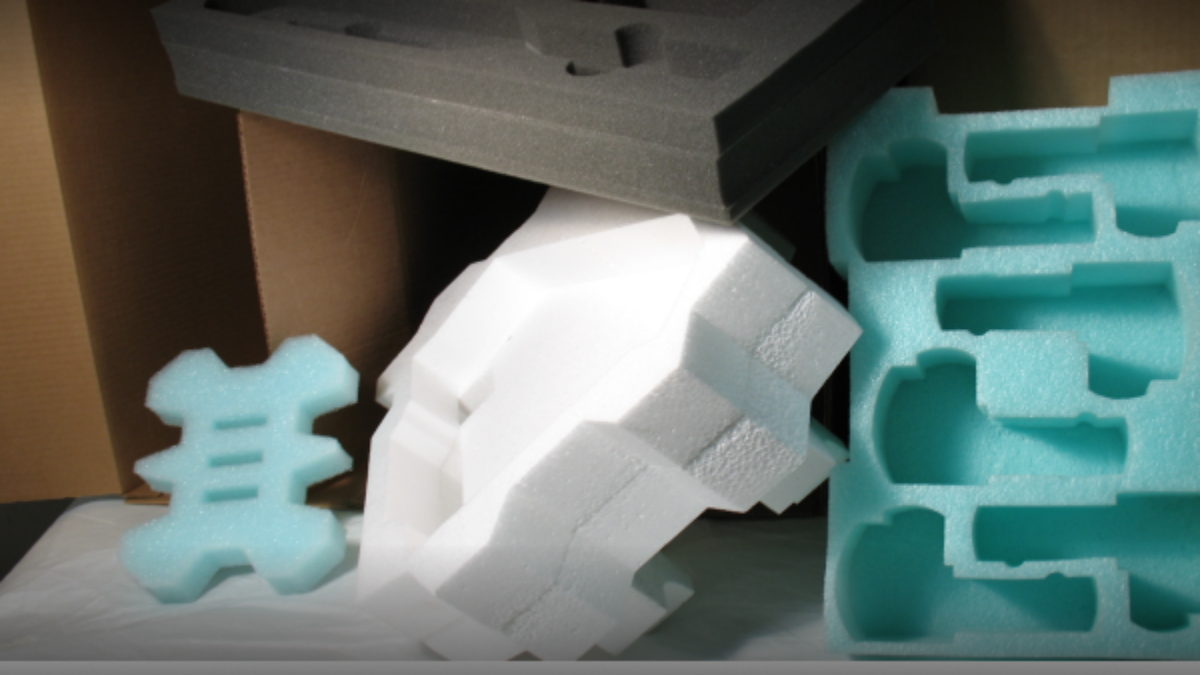
Smarter packaging starts with custom-fabricated foam solutions that deliver maximum protection with minimal material. Amcon’s engineering team designs every package to remove as much foam as possible while still fully protecting the item. Packaging designed to match a product’s exact geometry avoids the extra weight and freight costs of oversized packaging. Precision cutting minimizes packaging remnants, so more raw material ends up in a finished part.
Market Demand Is Shifting Toward Custom Packaging Solutions
The packaging industry is already responding to sustainability concerns. According to Fact.MR’s Recyclable Foam-In-Place Market report, demand for recyclable foam-in-place systems is being driven by tightening packaging regulations, corporate sustainability targets, and continued e-commerce growth.
While no solution offers 100% carbon-free shipping, custom foam inserts can help reduce the shipping industry’s environmental footprint by lowering the number of packages damaged in transit.
Working With Amcon
In 2025, Amcon received a Pregis Purpose Award for reducing carbon emissions by 150 metric tons. While we remain committed to sustainability, our niche is versatility. We offer the widest range of foam materials, a team of engineering experts, and a state-of-the-art fabrication facility, all under one roof. The most sustainable packaging solution is the one that gets it right the first time.
Connect with the Amcon team to review your current packaging and identify opportunities to enhance protection, reduce shipping costs, and improve sustainability.