

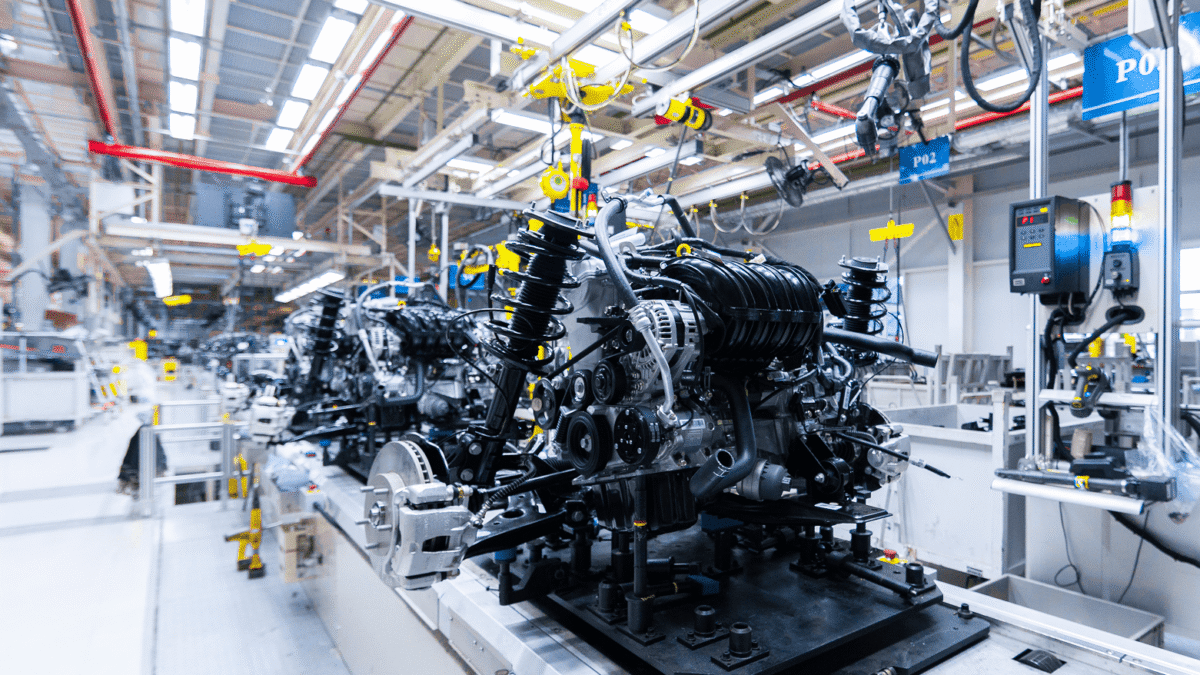
We trust cars and planes to transport us safely every day. And foam plays a critical role in our safety. Beyond padding in seating, foam lines door panels, cushions, bumpers, and isolates mounts and gaskets. In every one of these locations, it must withstand the constant vibration of a moving mechanism, cycle after cycle, for years.
Vibration is a constant force across automotive and aerospace environments. That vibration causes premature wear, accelerated fatigue, and damage to delicate parts. It also generates noise as structure-borne vibration converts to airborne sound in the cabin, affecting comfort and product quality. Protecting components from vibration is a core design requirement for vehicles and aerospace equipment that must operate reliably over long service lives.
Vibration Damping and Fatigue Resistance: Why They Go Together
Vibration damping addresses energy absorption and dissipation before vibration transfers into the structure. Fatigue resistance addresses how the material holds up after thousands of loading cycles.
Research published in the Journal of Vibration Engineering & Technologies found that structural failures in aircraft components often begin with “fatigue-induced crack initiation at stress concentration zones,” and that damping-based mitigation measurably improved fatigue resistance in those components. That finding highlights a point automotive and aerospace engineers already know. Damping and fatigue performance are not separate specs. A foam that damps vibration well but degrades under repeated compression will eventually stop protecting the component it was meant to isolate.
Automotive Foam: Isolating Structure-Borne Vibration
Automotive components face constant, repetitive vibration from the engine, road surface, and drivetrain, along with exposure to heat, oil, and moisture under the hood.
Key properties for automotive applications:
- Resistance to compression set under sustained load, so gaskets and mounts hold their shape over years of engine and cabin vibration
- Oil, fuel, and moisture resistance for under-hood and undercarriage placement
- Sound and vibration isolation that improves cabin comfort without adding significant weight
Neoprene and EPDM foams are common choices for engine bay isolation pads, engine mounts, pump and compressor mounts, and door panel and bumper cushioning. Both resist heat, ozone, and weathering for components that live in the engine compartment or are exposed to the elements.
Expanded Polypropylene (EPP) foam delivers reliable shock absorption and shape recovery after repeated impact. That makes it a fit for reusable automotive components and structural cushioning, where the foam needs to perform the same after multiple compression cycles as it did on the first. Foam density also plays a direct role. Higher-density grades hold their shape under sustained engine and drivetrain vibration, while lower-density grades suit lighter cushioning needs.
Aerospace Equipment: Damping Without Adding Weight
Weight is a defining constraint in aerospace vibration control that automotive applications don’t face to the same degree.
Key properties for aerospace applications:
- High damping performance at low density
- Long-term dimensional stability under sustained vibration and temperature extremes
- Compatibility with flammability and material standards required in aircraft interiors and structural assemblies
Polyurethane (PU) foam is widely used in aerospace seating for its combination of comfort and vibration damping, holding up under the repeated cyclic loading seating applications require. For structural and interior components that need more rigidity, closed-cell polyethylene (PE) and cross-linked polyethylene (XLPE) foams provide dimensional stability under load while still interrupting the transfer of structure-borne vibration. These materials maintain consistent damping and structural properties across a wide temperature range, from cold-soaked cruising altitude to heat-soaked tarmac.
What Research Shows About Fatigue and Compression Set
Vibration damping performance is only half of the picture. A study of closed-cell EVA foam under repeated compression cycling traced mechanical property loss back to two mechanisms at the cell-wall level: creep-induced buckling and the gradual formation of tears in the thin walls between cells. As those tears accumulate, gas moves more freely between neighboring cells, which temporarily increases damping resistance, before overall stiffness and energy absorption continue their decline. A foam that holds its properties over years of service is one whose cell walls degrade slowly and predictably enough that damping performance stays within spec for the life of the part.
This is why compression set resistance carries as much weight as initial damping performance when specifying foam for long-service components. A foam that dampens vibration effectively on day one but loses that performance after a season of engine heat cycles, or a year of flight hours, isn’t solving the problem it was chosen to mitigate.
Choosing the Right Foam for Reliable Vibration Isolation
Whether you’re isolating engine bay components or cushioning aircraft interior assemblies, the right foam controls vibration, resists fatigue and extends product life.
At Amcon Foam, we evaluate material behavior, density, geometry, and environmental conditions to engineer the right solution for your application. With CNC routing, waterjet cutting, die cutting, contour cutting, and skiving in-house, we cut, shape, layer, and optimize every vibration-control component to your exact specifications.
If you need guidance selecting the ideal foam for your vibration-control application, we are happy to help. Talk to a foam specialist to review material options.