

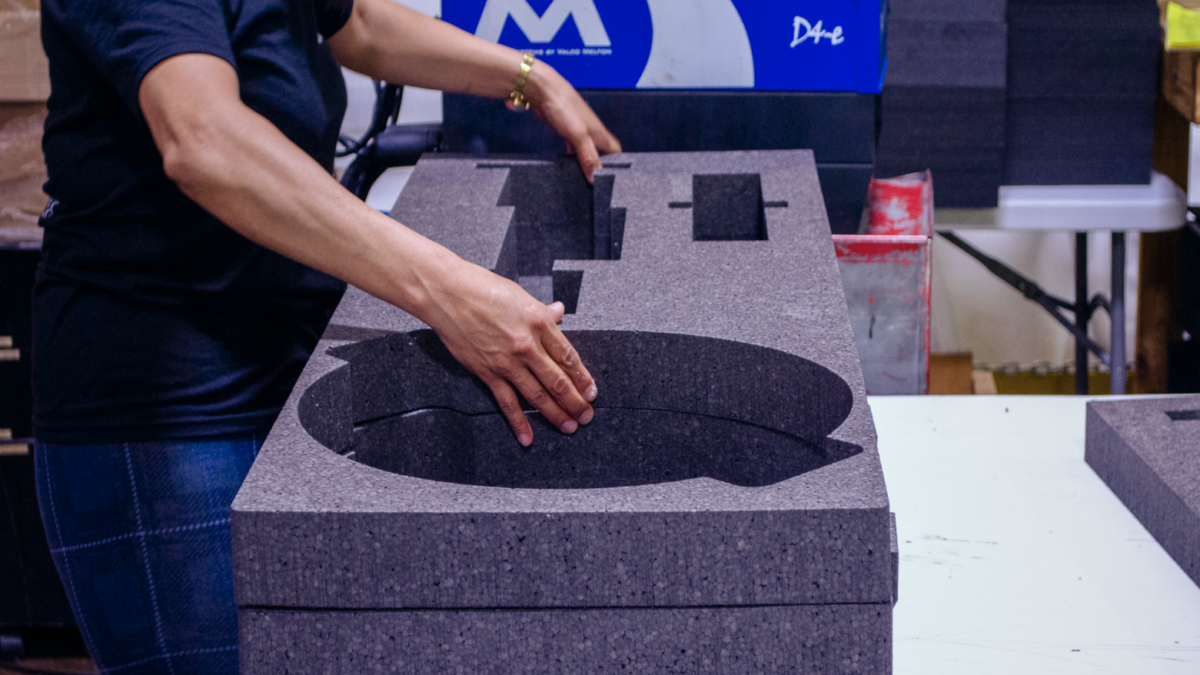
Protective packaging rarely has a single requirement. Products may need cushioning, structural support, vibration control, or static protection during shipping, and one foam density cannot provide all of those characteristics at once.
Multi-layered foam construction solves this challenge by combining different foam types or densities into a single engineered structure. By laminating multiple layers together, packaging engineers can design protective systems that address impact absorption, structural support, and environmental protection in one solution.
The result is packaging designed around how a product actually moves through the supply chain.
What Is Multi-Layered Foam?
Multi-layered foam, often called laminated foam, combines two or more layers of foam bonded together into a composite material. The layers may use the same foam at different densities or combine different materials selected for specific performance characteristics.
Common bonding methods include heat lamination, hot-air bonding, and adhesive bonding, depending on the materials involved and the performance required.
A custom foam insert might include:
- A rigid polyethylene foam base that provides structural stability
- A softer polyurethane foam layer that cushions the product
- A specialty layer designed for static control or environmental resistance
Each layer performs a specific function. Engineered together, they create a protective packaging system that outperforms any single-density foam alone.
Why Single-Density Foam Has Limits
Foam performance varies based on density, cell structure, and material composition. These characteristics determine how a foam compresses, absorbs shock, and supports weight.
Higher-density foams excel at load-bearing, compression resistance, and structural stability. Lower-density foams provide softer cushioning, better vibration absorption, and reduced risk of surface damage. Many packaging applications require both behaviors at the same time, and a single-density material may only compromise between them. Multi-layered foam removes that constraint while keeping foam weight and packaging dimensions in check.
How Layered Foam Improves Packaging Performance
Impact Absorption and Shock Protection
Foam layers distribute impact forces throughout the packaging system. A rigid layer stabilizes the product while softer layers absorb energy during drops or handling events, reducing the likelihood that impact forces reach the product directly.
Structural Support for Heavier Items
Higher-mass products place greater stress on packaging during shipping and storage. Closed-cell foams with strong load-bearing capacity help maintain structural integrity and prevent deformation during stacking or long-distance transport, without sacrificing protection for sensitive components.
Environmental and Chemical Protection
Some shipping environments expose packaging to oils, solvents, moisture, or cleaning agents. Cross-linked polyethylene foam can be incorporated as a dedicated layer to provide chemical resistance while maintaining cushioning performance. Closed-cell foam structures also contribute thermal insulation and moisture resistance without significantly increasing packaging weight.
Noise Reduction and Vibration Control
For sensitive instrumentation and mechanical equipment, layered foam can dampen both sound and vibration during transport. Certain materials function as acoustic layers, absorbing mechanical energy before it reaches precision components. This is particularly relevant for industrial equipment and instruments that are sensitive to vibration over long transit distances.
Electrostatic Protection for Electronics
Electronics, circuit boards, and sensitive medical devices face risk from electrostatic discharge during shipping and handling. Anti-static or conductive foam layers integrate directly into a multi-layer system, providing ESD protection without compromising cushioning or structural stability.
Surface Protection and Presentation Packaging
Some components require non-abrasive contact surfaces to protect cosmetic finishes or Class A surfaces. A softer foam layer handles direct contact while denser layers beneath it maintain overall package stability. This construction is common in equipment cases, demonstration kits, and presentation packaging for high-value products.
Foam Materials Used in Multi-Layer Packaging
Material selection depends on the product being shipped and the conditions it may encounter in transit. Amcon works with a wide range of foam materials to design layered packaging systems. The most commonly specified include:
Expanded polyethylene foam (EPE): A lightweight closed-cell foam with strong cushioning performance. EPE is non-crosslinked and fully recyclable, making it a practical choice where environmental impact is a consideration.
Expanded polypropylene (EPP): A durable beaded foam with excellent impact resistance and shape recovery. Well suited to reusable packaging and engineered foam dunnage programs that require repeated performance.
Polyethylene foam (PE): A versatile closed-cell foam available across a wide density range, with good moisture resistance and broad fabrication compatibility.
Polyurethane foam (PU): A flexible open-cell foam that provides vibration dampening and cushioning. It is a common choice for medical devices, precision instruments, and applications where the foam needs to conform to complex shapes.
Cross-linked polyethylene foam (XLPE): A uniform, fine-cell foam with strong dimensional stability, chemical resistance, and durability. It sees frequent use in gaskets, precision inserts, and medical device packaging.
Expanded polystyrene (EPS): A rigid foam used for structural packaging and thermal insulation, particularly in temperature-controlled shipping applications.
ESD and anti-static foams: Available in static-dissipative and conductive grades for electronics protection and sensitive component handling.
Fire-resistant and military specification foams: Used in regulated environments and defense applications where materials must meet defined compliance standards.
Where Multi-Layered Foam Packaging Is Used
Protective Packaging and Engineered Foam Dunnage
Custom foam inserts designed around product geometry prevent movement during shipping while absorbing shock and vibration. Engineered foam dunnage keeps components secure throughout transportation without relying on loose packaging materials.
Medical Devices and Precision Equipment
Medical devices and laboratory instruments often require packaging that balances cushioning, dimensional stability, and chemical resistance. Layered foam systems address all three in a single construction.
Presentation Packaging and Equipment Cases
Layered foam inserts serve both protective and presentational functions. These inserts appear in demonstration kits, field equipment cases, and high-value product packaging where presentation matters as much as protection.
Military and Government Packaging
Military packaging frequently requires specific foam materials such as FRAS polyethylene or military specification urethane foams. Multi-layer designs help meet strict performance requirements while protecting complex equipment during transport.
Multi-Component Product Kits
Kits with multiple components benefit from tiered foam designs that give each part its own cavity. Components stay organized, secure, and easy to access during use or assembly.
Fabrication Methods for Multi-Layer Foam Systems
Material selection and construction design are only part of the equation. The fabrication method determines how accurately the final insert matches the product geometry. Amcon’s fabrication capabilities include:
- Die cutting: high-volume parts with consistent tolerances
- CNC routing and pattern cutting: detailed inserts and multi-depth cavities
- Waterjet cutting: complex geometries without heat distortion
- Contour cutting: three-dimensional foam forms in horizontal and vertical orientations
- Foam lamination: bonding layers into a single engineered structure using heat, hot-air, or adhesive methods
Engineering the Right Protective Packaging System
Designing multi-layered foam packaging means evaluating the full picture. That includes product weight and fragility, shipping and handling conditions, environmental exposure, packaging geometry, and performance requirements like shock absorption or static protection. Well-designed foam packaging also reduces the environmental impact of shipping by minimizing product damage, cutting material waste, and improving supply chain efficiency.
At Amcon, every packaging project begins with a detailed analysis of the product and its distribution environment. With more than 45 years of foam fabrication experience and manufacturing locations in Minnesota and Colorado, our team develops solutions tailored to each application, from single custom inserts to high-volume engineered dunnage programs.
Contact Amcon Foam to request a quote and discuss the right protective packaging system for your application.