

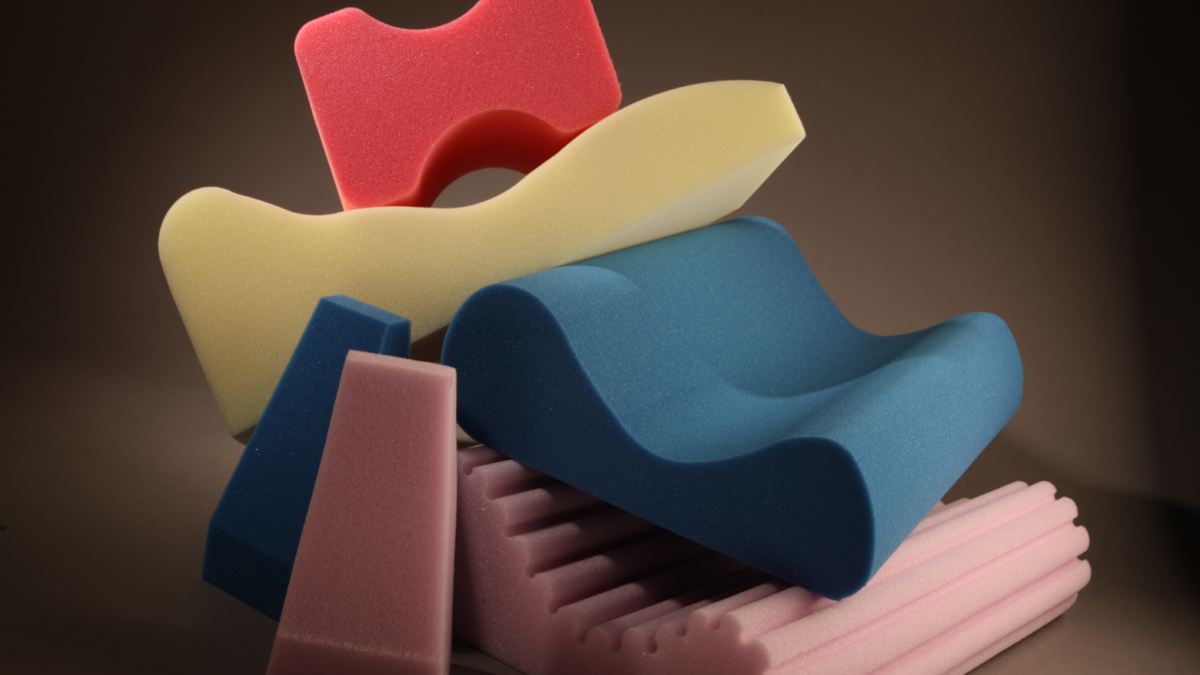
The right medical foam delivers patient comfort, protects sensitive devices, and holds up through the demands of clinical use. Selecting it requires evaluating density, compression, memory, antimicrobial characteristics, washability, and fabrication precision together. Each property determines how a product performs throughout its entire service life.
Medical Device and Pharmaceutical Packaging
Foam packaging for medical devices and pharmaceuticals has two jobs: protecting sensitive instruments during transit and insulating temperature-sensitive medicines from environmental variation. Both require precise material selection.
Expanded polyethylene foam (EPE) is a primary material for medical device packaging. Its closed-cell structure provides cushioning and shock absorption while blocking moisture ingress. EPE gives packaging engineers flexibility to match cushion performance to device weight and fragility. It delivers omni-directional compressive strength and a Class A surface that protects sensitive finishes from abrasion.
Polyethylene foam (PE) serves applications requiring broad chemical resistance and moisture protection across a wider density range. PE resists hydrolysis, mold, and mildew growth, and is available in anti-static and fire-retardant variants for applications requiring multiple performance criteria alongside cushioning.
Polyurethane foam (PU) serves packaging applications where device geometry is complex. PU conforms to irregular shapes, distributes contact force across the full device surface, and is fabricated into precise cavity inserts using CNC routing or waterjet cutting. For devices requiring both structural support and surface protection, layered EPE and PU foam materials address both in a single insert.
Expanded polypropylene foam (EPP) serves reusable medical packaging applications. EPP delivers excellent impact resistance and shape recovery through repeated handling cycles, making it well suited to returnable transport packaging and durable shipping programs for medical devices.
Medical Cushioning
The foam in a hospital mattress, bed cushion, lumbar roll, backrest, or wheelchair wedge must support load, relieve pressure, resist fungal growth, and hold up through repeated use and cleaning cycles. Each application places different demands on the material and selecting on density alone produces unreliable results.
The right material supports load without bottoming out, resists moisture through repeated cleaning cycles, and holds its specified shape across the full-service life of the product.
Three categories of ether polyurethane foam serve medical cushioning applications, each with a different compression and recovery profile.
- Standard ether PU covers general cushioning across hospital mattresses, beds, cots, and support products. A wide IFD range gives product designers flexibility in firmness and patient comfort. Ether PU is the preferred base for medical cushioning because of its superior hydrolytic stability. It resists moisture and holds up through repeated cleaning cycles.
- Viscoelastic foam grades are designed for pressure relief and pressure distribution. The defining characteristic is slow compression and slow recovery. These foams conform to patient anatomy and distribute pressure evenly across the contact surface. They are the appropriate choice for extended-contact applications where pressure distribution is a clinical requirement.
- High resilience (HR) grades are designed for load-bearing support. Where viscoelastic foam yields slowly, HR foam recovers quickly after compression, resisting compression set through repeated use and sustained load. Wheelchair wedges, specialized backrests, and lumbar rolls that must hold their specified shape over time are the applications HR grades are built for.
Many medical cushioning products require layered constructions. A wheelchair cushion might use an HR base for structural support with a viscoelastic top layer for pressure distribution at the contact surface. Multi-layer foam fabrication accommodates complex shapes, special inserts, and short-run or high-volume production.
Support Braces, Orthotics, and Prosthetics
Foam components in braces and orthotics must be comfortable against skin, washable, durable through daily use, and precise enough to deliver the intended therapeutic outcome. A brace that fits precisely provides consistent support. An orthotic insert held to its specified dimensions delivers consistent correction. Construction is often complex, involving multiple foam materials and fabrication steps.
Neoprene is the primary material for support braces. Its closed-cell structure resists moisture absorption. It is naturally form-fitting, which allows it to conform closely to anatomy and maintain consistent compression. It is flexible across a wide temperature range, physically tough, and tear resistant. Neoprene braces are fabricated for knee, lumbar, and other orthopedic support applications.
Cross-linked polyethylene foams (XLPE) are used in rigid orthotic components, including custom heel lifts and precision inserts. The cross-linking process produces a foam with uniform cell structure and dimensional stability that delivers tighter tolerances and greater resistance to deformation under sustained load. Irradiation-cross-linked XLPE is also clean and resistant to off-gassing, which is relevant in direct-contact applications.
Expanded polyethylene (EPE) serves applications requiring lightweight cushioning with a Class A surface. In orthotic and prosthetic applications, EPE is used where surface protection and repetitive impact resistance are required alongside low weight.
Amcon is a leading supplier to the prosthetics and orthotics industry. These products often require complex construction, multiple foam materials, and precise foam fabrication. Specialized short-run orders and long-term mass production are both accommodated, with fast prototyping and turnaround available for development programs.
Selecting the Right Medical Foam for the Application
Density and IFD must be evaluated together. Density determines how much foam is present per cubic foot. IFD measures how much force is required to compress the foam 25 percent. A foam can be dense with low firmness, or firm at lower density. Selecting on either number alone produces unreliable results.
Compression and recovery profile determine therapeutic performance and patient comfort. Viscoelastic foam grades compress slowly and recover slowly. HR grades compress and recover quickly, with strong compression set resistance. Standard ether PU sits between them. Matching the profile to the clinical requirement is the selection decision.
Antimicrobial foam characteristics require evaluation in patient-contact applications. Foam that retains moisture or supports microbial growth creates infection risk. Material selection, cell structure, and surface treatment all affect antimicrobial performance.
Fabrication precision determines clinical fit. A brace, orthotic insert, or cushioning component that varies from its specified dimensions delivers inconsistent therapeutic outcomes. Complex shapes, layered foam materials, and special inserts are fabricated to exact specifications. Full-service capabilities include applying the cover and private labeling in-house.
At Amcon, every healthcare project begins with a detailed evaluation of the product and its performance requirements. With more than 45 years of foam fabrication experience and manufacturing locations in Minnesota and Colorado, our team develops solutions tailored to each application, from single custom components to high-volume production programs.
Contact Amcon Foam to discuss your healthcare application.